Getting startedExplainer
Can a Complete Beginner Learn to Trade?
Answer
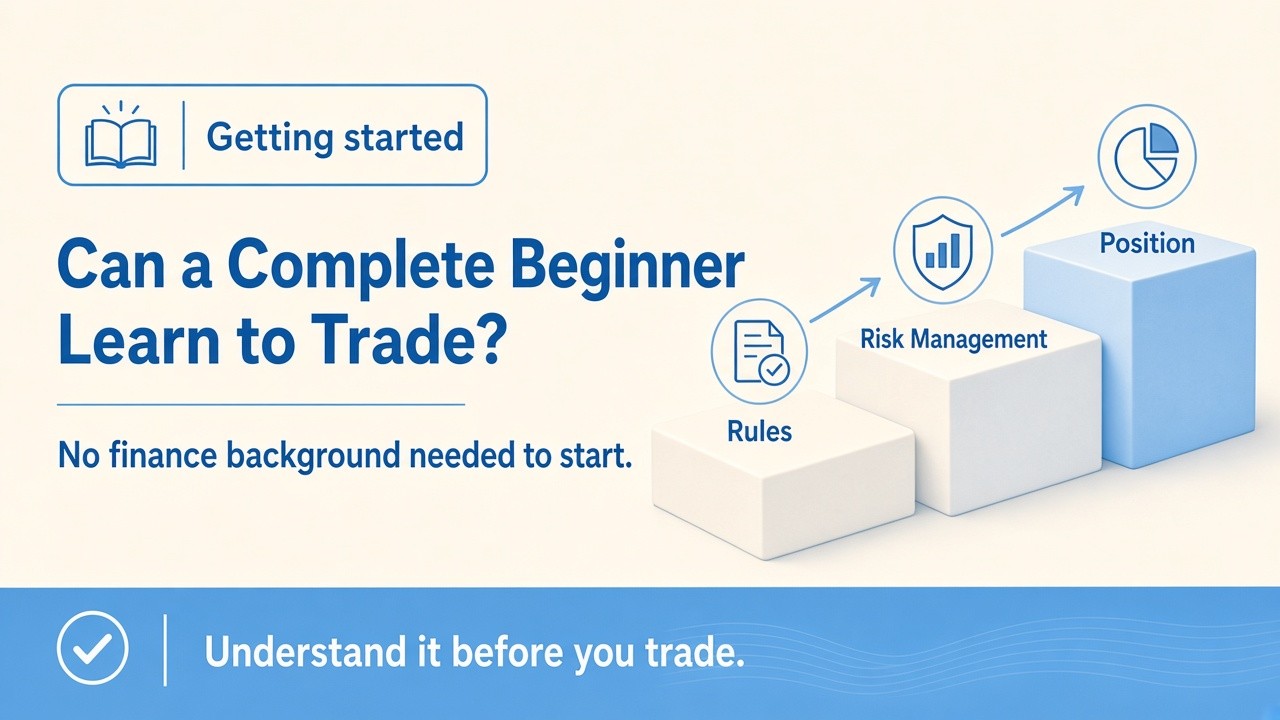
Yes — and most people who trade seriously did not start with a finance degree. You do not need to memorize a glossary first, and you do not need "insider tips" to be allowed to practice. You do need to accept something else: trading is first about risk management and written rules, not about who guesses tomorrow's direction better. A complete beginner can start by separating Trading vs Investing and learning how much one trade is allowed to lose. People who "cannot learn" usually did not lack IQ — they jumped straight into signals, copy-trading rooms, and living money spent to test someone else's slogan.
Contents
Key definitions
- A finance degree is not a ticket
- Accountants, engineers, salespeople and programmers all become traders later. What is usually missing is time, discipline, and ownership of your own rules — not a diploma.
- Three things to learn first
- ① How much you will allow one trade to lose; ② the price that means you were wrong (stop); ③ the size that fits that risk. That beats memorizing ten indicators.
- Beginner traps
- Treating "learn to trade" as "learn to call direction"; treating a teacher's screenshot as proof; practicing with borrowed money or next month's rent.
- Realistic expectations
- The first months feel more like learning to drive than chasing speed. Most people pay some tuition. The goal is to keep that tuition inside a budget you can accept, and to leave records you can review.
- Suggested order
- Trading ≠ investing → position size and stops → paper or tiny live size through a full open/close loop → strategy details last.
- When to pause
- You keep breaking your own rules, sleep badly, or add size out of emotion — pause. That matters more than "one more trade to get it back."
What this page does not cover
- "Can learn" is not "can make steady profit." No path guarantees money.
- This page does not recommend specific instruments, leverage, indicator stacks, or signal services.
- Do not practice with money you need for living costs or with borrowed funds.
- Education does not replace your own judgment or the rules where you live.
FAQ
I am bad at math — am I out?
Position sizing mostly uses add/multiply/divide and "risk amount ÷ loss per unit." The hard part is running the formula every time, not the formula itself. How to calculate position size covers the skeleton.
Do I need a certificate before I start?
A certificate is not an entry ticket. More useful: you can state your entry/exit rules, your risk cap per trade, and what you do after a loss. Study for exams later if you want.
Charts first, or risk management first?
Risk first. Without chart skills you take fewer trades; without size control a correct call can still wipe the account. See What is position sizing?.
I watched many "sure win" videos and still freeze — is that normal?
Yes, and often healthy. The danger is "listen once, then go all in." Use a demo or a size too small to hurt daily life, and practice only the loop: place, stop, close, journal.
What is enough for week one with zero background?
Know how trading differs from investing; write "max loss per trade as a % of the account"; size one imaginary trade with the formula; note when you tend to act on impulse. Skip the hunt for a magic indicator.
If I still struggle, does that mean I am not cut out for this?
More often the order was wrong: direction first, accepting losses last. Flip the order and give yourself time. If you still cannot follow rules, long-term allocation — or not trading at all — is fine. Not trading is not a failure.